SCIENTIFIC PROGRAMS AND ACTIVITIES

May 24, 2012

THE FIELDS INSTITUTE
FOR RESEARCH IN MATHEMATICAL SCIENCES

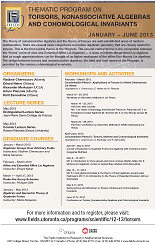
January–June 2013
Thematic Program on Torsors, Nonassociative Algebras and Cohomological Invariants

Organizing Committee
Vladimir Chernousov (Alberta), Erhard Neher (Ottawa) , Alexander Merkurjev (UCLA), Arturo Pianzola (Alberta), Kirill Zainoulline (Ottawa)
Scientific Committee
Georgia Benkart (Wisconsin), Eric Friedlander (USC), Ivan Panin (Steklov Mathematical Institute at St. Petersburg), Zinovy Reichstein (British Columbia)

Registration for Program activities open shortly
Contact thematic<at>fields.utoronto.ca
Concentration Periods Program Postdoctoral Fellowships
Application for participation support open shortly Graduate Courses Accommodation in Toronto Resources for Visitors


The program will start in January with an intensive introductory course on algebraic groups, see below for more details. The introductory course will be followed by two concentration periods:

I. Applications of torsors to infinite dimensional Lie theory;

II. Torsors, motives and cohomological invariants

aligned with the main themes of the program. Each period will feature several mini-courses and lecture series aimed at young researchers and students. At the end of each period we plan to have a mini-workshop with more specialized talks.

We plan to organize two seminar series, one more traditional with invited speakers (established researchers and postdocs) and a second one in the form of learning seminars aimed at graduate students and young researchers.

At the end of the program (June 9-15, 2013) we plan to have a conference summarizing the activity of the semester.

Intensive introductory course on algebraic groups

January-March 2013
Graduate course on Algebraic Groups over arbitrary fields

Lecturers: Vladimir Chernousov and Victor Petrov
The primary goal of the course is to provide an introduction to the theory of reductive algebraic groups over arbitrary fields and local regular rings. The main objectives are to give some basic material on their structure and classification.

Concentration Periods

I. February - March, 2013
Applications of torsors to infinite dimensional Lie theory
( organized by V. Chernousov, E. Neher and A. Pianzola)

Graduate course on Affine and Extended Affine Lie Algebras (E. Neher)

The aim of this course is to provide the participants of Concentration period I with the necessary background from the structure theory of affine and extended affine Lie algebras. The course will run from early February to mid-March.
Contents. Review of split simple finite-dimensional Lie algebras and affine Kac-Moody Lie algebras. Extended affine Lie algebras: Definition, examples, first properties. Reflection systems, in particular affine reflection systems and extended affine root systems. Lie tori: Definition, properties, examples. Relation between Lie tori and extended affine Lie algebras. Classification of Lie tori.

Mini course 1: Galois cohomology and descent theory (A. Pianzola)

Review of absolute Galois group of a field. Non-abelian Galois cohomology. Twisted forms of algebras (case of fields). Faithfully flat descent. Galois extension of rings. Twisted forms of algebras (case of rings). Multiloop algebras. Algebraic fundamental group of Laurent polynomials. Loop and toral torsors. Internal characterization of multiloop algebras. Acyclicity theorems and applications to the classification of multiloop algebras.

Mini course 2: Reductive group schemes (P. Gille)

Definition of affine group schemes, group actions, representations. Link with Hopf algebras and comodules. Descent, quotients, examples of representable functors (e.g. centralizers, normalizers). Diagonalisable groups and groups of multiplicative type. Grothendieck's theorem of existence of tori locally for Zariski topology, applications. Split subtori, root data, parabolic subgroups, Levi subgroups. Classification of reductive group schemes by cohomology, examples of forms.

Learning Seminar

The mini courses will be complemented by a learning seminars, one on "Conjugacy Theorems", organized by V. Chernousov, P. Gille and A. Pianzola.

The concentration period will end with:
March 18 - 29, 2013
Workshop on Geometric methods in Lie theory

II. April-June, 2013
Torsors, motives and cohomological invariants

(organized by V. Chernousov, A. Merkurjev and K. Zainoulline)

Course: Introduction to quadratic forms and algebras with involutions (Anne Queguiner-Matthieu).

Basics on quadratic and bilinear forms. Witt ring. Quadratic forms under field extensions. Generic splitting properties. Witt index. Classification of quadratic forms in small dimensions. Basics on algebras with involutions. Clifford algebras.

Mini-Course 3: Introduction to Chow groups and Chow motives (Stefan Gille).

Chow groups (pull-back, push-forward, homotopy invariance, localization). Characteristic classes. Basics on the Intersection theory.

Chow motives. Motives of flag varieties (cellular decomposition, Bruhat-Tits decomposition). Rost nilpotence and the Krull-Schmidt Theorem.

Mini-course 4: Local-global principles in the theory of linear algebraic groups (Julia Hartmann)

In this course, we consider local-global principles for torsors when the base field is an algebraic function field over a complete discretely valued field. We compute the obstructions to these principles with respect to certain other families of overfields. The results then give insight about the original local-global map with respect to discrete valuations. The proofs use patching methods.

Mini course 5: Motives and algebraic cycles on twisted flag varieties (Kirill Zainoulline)

Motives of twisted flag varieties is an important tool in the study of splitting properties of torsors, in the geometric theory of quadratic forms and central simple algebras with involutions. For instance, motives of Pfister quadrics played a key role in the proofs of the Milnor conjecture on quadratic forms and the Bloch-Kato conjecture. Another applications include cohomological invariants, the theory of canonical and essential dimensions of linear algebraic groups.

The course will survey some of this research. It will be started with an introduction to the theory motives of twisted flag varieties and conclude with a discussion of open problems. We will introduce and study the discrete motivic invariant of a torsor (the J-invariant), explain relations to canonical dimensions, K-theory, Chow groups, algebraic cobordism of twisted flag variaties and linear algebraic groups.

Mini-course 6: An introduction to the theory of essential dimension. (Zinovy Reichstein)

The essential dimension of an algebraic object is the minimal number of independent parameters one needs to define it. This notion was initially introduced in the context where the objects in question are finite field extensions. Essential dimension has since been investigated in several broader contexts, by a range of techniques, and has been found to have interesting and surprising connections to many problems in algebra and algebraic geometry.

The course will survey some of this research. It will be started with the definition of essential dimension and conclude with a discussion of open problems.

Learning Seminars

The mini courses will be complemented by two learning seminars, one on Algebraic cycles and motives of projective homogeneous varieties organized by N. Semenov and K. Zainoulline and the second one on Cohomological invariants organized by S. Garibaldi and K. Zainoulline

Mini lecture series:

During the mini-courses, we plan to have several lecture series (2 lectures each) on various topics in the direction of the program aimed at post-docs and researchers:

  • Cohomological invariants for exceptional groups by S. Garibaldi
  • Patching and a local-global principle by D. Krashen
  • Quadratic spaces over local regular rings by I. Panin
  • Algebraic cobordism and its applications to quadratic forms by A. Vishik

May 6-17, 2013
Spring school and Workshop on Torsors, Motives and Cohomological Invariants

June 10-14, 2013
Conference on Torsors, Nonassociative Algebras and Cohomological Invariants

Summarizing the activity of the semester.

Coxeter Lecture and Distinguished Lectures

TBA

Seminars

Seminars are important occasions for participants and short-term visitors to meet and exchange ideas. There will be two types of seminars, a more traditional seminar for established researchers and a second one for young researchers and participating students.
The first seminar series will feature short-term visitors and participating postdoctoral fellows and will present finished research.
The second seminar will be rather informal. Its aim is to provide young researchers a forum to discuss their ongoing research, or to learn together some more advanced topics.

Postdoctoral Fellows and Program Visitors

Postdoctoral fellowship applications
We will support a number of Fields postdocs for the duration of the program, as well as offer support towards a visitors' program, including visiting Ph.D. students For Postdoctoral Fellowships click here

Program Participants requesting support or office space
All scientific events are open to the mathematical sciences community. Visitors who are interested in office space or funding are requested to apply by filling out the application form (open shortly). Additional support may be available to support junior US visitors to this program.
Fields scientific programs are devoted to research in the mathematical sciences, and enhanced graduate and post-doctoral training opportunities. Part of the mandate of the Institute is to broaden and enlarge the community, and to encourage the participation of women and members of visible minority groups in our scientific programs.


For additional information contact thematic(at)fields.utoronto.ca

Back to Top