|
|
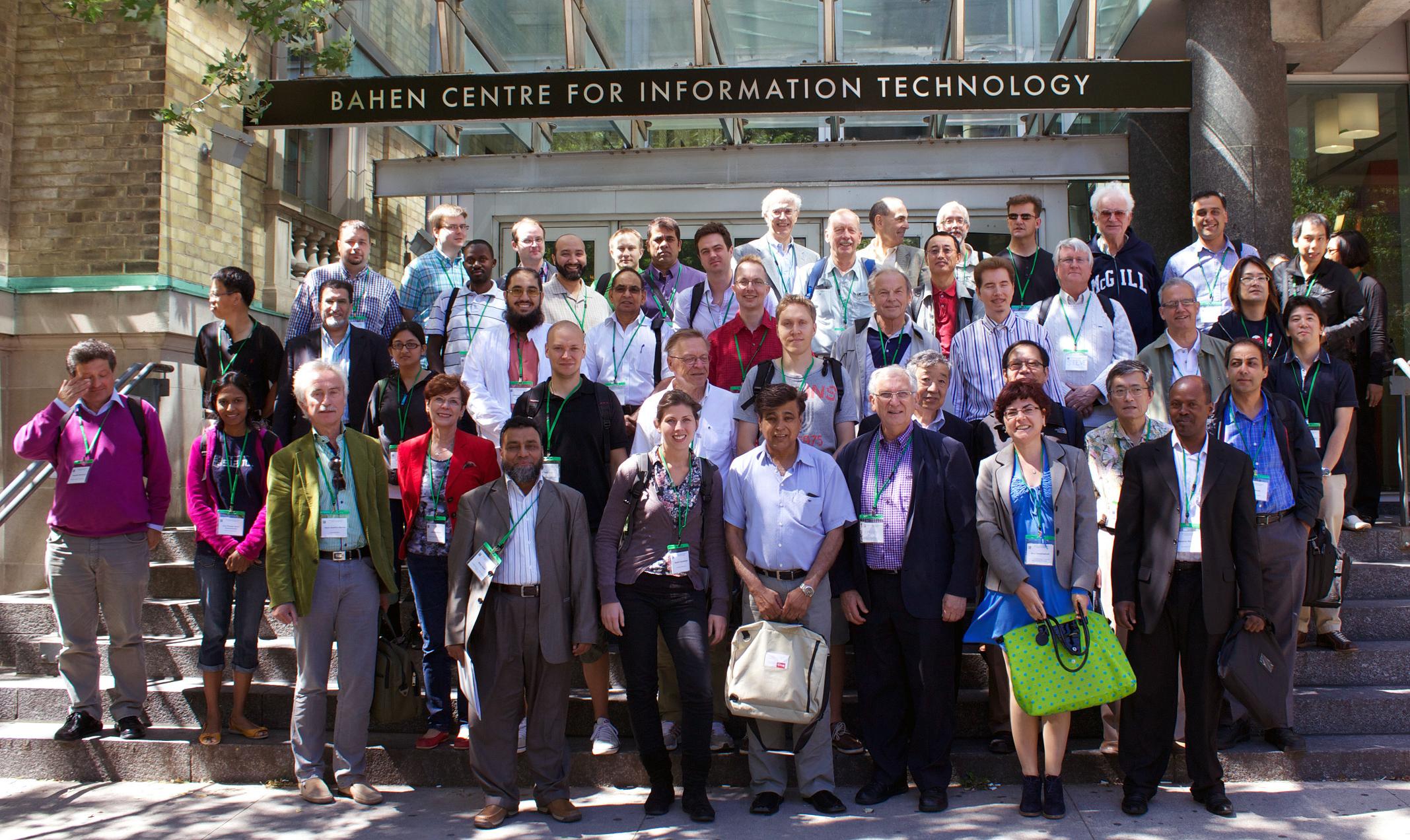
Click image for larger version
OVERVIEW
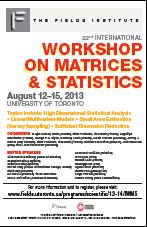
The purpose of the workshop is to bring together researchers
sharing an interest in a variety of aspects of statistics
and its applications as well as matrix analysis and its applications
to statistics, and offer them a possibility to discuss current
developments in these subjects. The workshop will bridge the
gap among statisticians, computer scientists and mathematicians
in understanding each other's tools. We anticipate that the
workshop will stimulate research, in an informal setting,
and foster the interaction of researchers in the interface
between matrix theory and statistics. Some emphasis will be
put on related numerical linear algebra issues and numerical
solution methods, relevant to problems arising in statistics.
The workshop will include invited talks and a special session
with talks and posters by graduate students.
Workshop Objectives:
(1) highlight and expand the breadth of existing methods in
matrix analysis and their potential for the advance of both
mathematical and statistical sciences;
(2) identify important directions for future research in the
theory of High dimensional statistical analysis; Linear/multivariate
models; Small area estimation (Survey sampling); Applications
(signal processing, Bioinformatics); Sufficient dimension
reduction; Matrices and computational statistics;
(3) facilitate collaboration between theoretical and subject-area
researchers; and
(4) provide opportunities for highly qualified personnel (HQP)
to interact with leading international researchers.
The topics that have been selected so far include estimation,
prediction and testing in linear models; robustness of relevant
statistical methods; estimation of variance components appearing
in linear models; generalizations to nonlinear models; design
and analysis of experiments, including optimality and comparison
of linear experiments; and applications of matrix methods
in statistics.
|
Invited
Speakers
(titles and abstracts)
Mohamed Amezziane (Central Michigan University)
Oskar Maria Baksalary (Adam Mickiewicz)
Somnath Datta (Louisville)
Susmita Datta (Louisville)
Kai-Tai Fang (United International College, Zhuhai)
Ali Ghodsi (Waterloo)
Karl E. Gustafson (Colorado at Boulder)
Abdulkadir Hussein (Windsor)
Tonu Kollo (University of Tartu)
Steven N. MacEachern (Ohio State)
Ingram Olkin (Stanford)
Jianxin Pan (Manchester)
Serge Provost (Western)
Shuangge Ma (Yale)
Fuzhen Zhang (Nova Southeastern)
|
Invited
Special Sessions
(titles and abstracts)
Special Session to celebrate
Lynn Roy LaMotte's 70th Birthday
Speakers: David A. Harville
Lynn Roy LaMotte
J. N. K. Rao
Special Session on Applied Probability
(Organized by Jeffrey Hunter)
Speakers: Iddo Ben-Ari
Minerva Catral
Sophie Hautphenne
Jeffrey Hunter
Jianhong Xu
Special Session of Statistical
Inference on GLM
(Organized by Krishna Saha, Central CT State University)
Speakers: Dianliang Deng
Severien Nkurunziza
Krishna Saha
Samiran Sinha
Jihnhee Yu
Memorial Session to honor
Shayle R. Searle
(Organized by Jeffrey J. Hunter)
Speakers: David A. Harville,
Jeffrey J. Hunter,
J. N. K. Rao,
Robert Rodriguez,
Susan Searle
Special Session
on Perspectives on High Dimensional Data Analysis
(Organized by: Muni Srivastava)
Speakers: Shota Katayama
Abbas Khalili
J. S. Marron
Takahiro Nishiyama
Martin Singull
Muni Srivastava
Anand Vidyashankar
Takayuki Yamada
Hirokazu Yanagihara
Invited Special Session on Open-Source
Statistical Computing (Organized by Reijo
Sund)
Speakers: Antti Liski
Reijo Sund
Kimmo Vehkalahti
|
Journal of Statistical computation and
simulation (JSCS).
Papers for the Special Issue must be submitted within three
months of the conference. These papers must have [SPECIAL
ISSUE: Matrix] appended to the title. The review process
will be completed within nine months of the conference date.
Please keeping in mind that a Special Issue is not a proceedings.
Presenting a paper does not imply publication in a Special
Issue. The deadline for the paper submission is January
15, 2014 Papers for the Special Issue must be submitted
within three months of the conference At which time accepted
papers will be sent to the publisher, moved to the top of
the queue and published as soon as possible thereafter.
Papers accepted after that date will be added to the queue.
back to top
|