|
|
|
|
|
||||||

|
|
|
SCIENTIFIC PROGRAMS AND ACTIVITIES |
|
||||||
| April 25, 2024 |
|
|||||||||
|
To
be informed of Program updates please subscribe to the Fields maillist.
ObjectivesIn the one-month program, the many connections with other fields will appear,
but a focus will be provided by emphasizing the distributions of the noncommutative
variables. Such variables, like the quantum mechanical observables are operators
and the distributions are expectations associated with them. In the case of
one variable the noncommutative distributions are expectations of spectral
measures and are classical, i.e. probability measures, For several variables
such distributions are expectation values of noncommutative monomials (there
are many more of these than commutative ones). The program will emphasize
in all parts of free probability the distributions aspect: explicit determinations
of distributions if possible, methods of computing distributions, uses of
facts about distributions in applications. This is a timely topic since recent
developments in a variety of directions in free probability are also advances
in the distributions aspect, ranging from new noncommutative analysis tools,
new combinatorial and discrete mathematics aspects, the appearance of new
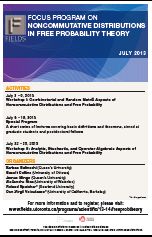
quantum symmetries and new types of distributions. Scientific ActivityProgram activities will be around two one-weekworkshops (at the beginning and at the end of July) and, in the 2 weeks between workshops, seminars and other activities, mostly especially adapted for the very young (including graduate students and postdocs). Workshop on Combinatorial and Random Matrix
Aspects of Noncommutative Distributions and Free Probability Workshop on Analytic, Stochastic, and Operator
Algebraic Aspects of Noncommutative Distributions and Free Probability Application for travel support now closed
-deadline to apply was May 31, 2013 |
|
||||||||
| ||||||||||